I’m on a bit of a sabbatical from writing for the blog. I will probably pick it up again in the spring and at least try to write something quarterly. Meanwhile I hope you will join me in supporting Movember your own way. I won’t have a personal site this year, but you can set up to make a contribution here if you wish: https://us.movember.com
Please consider starting your own campaign and invite your friends and family to support the cause. It’s not that hard!
Meanwhile I hope everyone has a safe and happy holiday season and I’ll see you next year.
To view this blog on my blog site, subscribe to future blogs (if any) and search for previous essays, please click here.
“Our patients lives and identities may be in our hands, yet death always wins. Even if you are perfect, the world isn’t. The secret is to know that the deck is stacked, that you will lose, that your hands or judgment will slip, and yet struggle to win for your patients. You can’t ever reach perfection, but you can believe in an asymptote toward which you are ceaselessly striving.” -Paul Kalanithi in “When Breath Becomes Air“.
This week, after considerable thought and with great ambivalence, I began saying goodbye to my patients. I have intentionally made my “retirement” a prolonged process, stretching back nearly 15 years and beginning with turning my research laboratory over to a wonderful trainee/fellow, Tom Flaig (now Vice Chancellor for Research at CU). I began to stop writing grants (for the most part), working more in the clinic on other people’s ideas, and continuing to write this blog while serving on various boards and IDMC panels (including with the two authors of that IDMC link). Eventually, I reduced my clinic time to one day/week, focusing entirely on prostate cancer and seeing patients only at our outreach site, the Shaw Cancer Center in Vail. But, as I anticipate turning 75 this summer, and as my wife has pointed out, “no one really wants an ‘over the hill’ physician” (even if that doctor is still doing well by his/her patients). It is time to leave the clinic. As Kalanithi points out, inevitably “your hands or judgment will slip”. And even if they haven’t or never do, I believe there is joy and elegance in stepping aside at the right time to provide opportunities for younger physicians to take your place and to the extent they wish, offer advice (wisdom?) if needed.
But what to do with a blog?? As an early adopter, I had great satisfaction helping ASCO develop its website, www.ASCO.org and wrote about what I envisioned as the evolution of internet oncology in this article. My colleagues and I assisted in moving much of the society’s print media online as well as hosting what I think may have been one of the first “virtual meetings” of a medical society in 1995. With the help of a contractor, we digitized 35mm slides, recorded audio, then merged them “by hand” and posted presentations on the internet (within hours of their live presentation) for viewing around the world. Shortly thereafter, I was invited to write medical blogs, and when that effort became commercialized with ads, I elected to start writing this blog “commercial free”. As the internet technology continued to evolve with the evolution of social media (twitter, instagram, tiktok, etc.) I opted out, and so this blog is all that remains of my “brief but spectacular” foray into content creation for the digital world.
The statistics on 733 subscribers to this blog suggest that relatively few visit the website, although I suspect more read the essays themselves which are sent out by the site as emails. Here are the stats for the last quarter:
The way you got this email (or link if you are reading on the wordpress site) is “push technology”. You opted in/subscribed to receive the emails. This led me to wonder what happens to an email or blog when you change pages or “delete”. We all know that they stay somewhere “forever”. I know this means bits and bytes on some server. But when I tried to think about it in Kalanithi terms to title this essay, I tried to imagine “When Pixels Become Electrons” or something similar. I failed. Here is how pixels work and this is how electrons control them. What happens to blogs is still mysterious to me, but I’m switching formats to “pull technology”: responding to queries/ideas rather than guessing what you might want.
There are now numerous online sources for prostate cancer information. If you want excellent push technology to keep you up, I recommend subscribing to “The Prostate Cancer Daily” written by and for experts in the field. If you want to look something up, like the latest clinical trials, please read this blog I previously posted.
Thus…I have decided to change states – just like the LCD crystals that change the polarization of the pixels that have turned black to provide you this text. Going forward, I will use this blog to try and help patients/families only IF they want, by responding to questions, but not by trying to guess what subjects may be of interest and creating a post. I am happy to do whatever research is necessary to explain advances and comment on the science behind them if you send a topic or question to me at prost8blog@gmail.com. I will post monthly answers here as essays on www.prost8blog.com so everyone can see them who is a subscriber. The person(s) who submit questions/ideas (if any) will remain anonymous and I will NOT provide case specific advice. I will also not send return emails from the gmail account except to indicate I have received your request/idea.
BOTTOM LINE: This will be the last post on this blog unless I receive a topic request or question at prost8blog@gmail.com. I will monitor that email site on a monthly basis and post here as needed. I have loved being a part of helping prostate cancer patients/families and wish the best to all of you who have subscribed. If the new approach works, great! And if not, I thank you (and your computer pixels) for sharing some of our lives together. Godspeed…
To view this post on my blog site, sign up for future posts, and search for other posts on a variety of topics, please click here.
This week brought excellent and exciting news from the ASCO GU Meeting about management of high risk prostate cancer using “triple therapy” for metastatic disease. Adding further evidence for the “kitchen sink” approach, Matt Smith from MGH presented data from the ARASENS trial. The study involved 1306 patients with metastatic prostate cancer (86% of whom presented with metastases and the remainder of whom developed mets while being followed after primary treatment). The trial evaluated whether adding the potent anti-androgen, darolutamide aka Nubeqa® (similar to enzalutamide and apalutamide) to standard ADT (e.g. orchiectomy, leuprolide, or other GnRH analog) plus docetaxel (Taxotere®) could improve survival. We already knew that 6 cycles of docetaxel added to ADT in this situation improved survival from the CHAARTED trial I wrote a blog about several years ago. This was the trial design:
The results of the trial were very positive and represent a new “standard of care” for patients with metastatic prostate cancer:
Although it is too early to say whether some of the patients in this or similar trials, such as PEACE 1, have been cured, it is clear that throwing the “kitchen sink” at prostate cancer can offer real improvement in survival. Now the questions become: Who are the patients most likely to benefit? What kind of toxicities do these patients have to put up with? How much does this kind of treatment cost? What if we added other known effective treatments like Lu-177-PSMA or PARP inhibitors to appropriately selected patients? Would adding this kind of treatment cure some patients with oligometastatic disease? And perhaps most intriguing, could we imagine applying this kind of treatment to patients with newly diagnosed, localized (but high risk …e.g. Gleason 8,9,10, or node positive) disease as part of a plan that involved prostate surgery or radiation?
The answer to all of these questions will come only from appropriately designed clinical trials. I am reminded, too, of the famous quote from one of the pioneers in prostate cancer treatment, Dr. Willit Whitmore who said, “Is cure possible? Is cure necessary? Is cure possible only when it is not necessary?” There are obvious differences between the 52 year old man who presents with high risk prostate cancer and is otherwise healthy versus a 79 year old gentleman who had prostate surgery 15 years ago, a pacemaker, and now has a rising PSA with only one or two metastases showing up on a PSMA-PET scan.
The progress in prostate cancer research has accelerated dramatically during my career. As well, the costs of oncologic care are rising at a faster rate than can be maintained, “National costs for cancer care were estimated to be $190.2 billion in 2015 and $208.9 billion in 2020 (2020 U.S. dollars), an increase of 10 percent that is only due to the aging and growth of the U.S. population… National oral prescription drug costs were highest for female breast, leukemia, lung, and prostate cancers” (See this reference) As an aging (rapidly…) man myself, I can only hope we are able to fall back on the precepts taught in Sir William Osler’s essay, “Aequanimitas“, combining the qualities of “imperturbability” and “equanimity” to achieve “”coolness and presence of mind under all circumstances”. If so, we should be able to navigate the avalanche of medical knowledge and associated costs with compassion, empathy, and wisdom. Meanwhile, hats off to the researchers and men who participated in clinical trials and brought this advance and many others you can see here to fruition.
To view this on my blog site, sign up to be notified of future posts or add comments, please click here.
In my book club (all old men from various backgrounds – medicine, law, business, politics, academia, etc.) we read a book called “Artificial Intelligence: Confronting the Revolution“. In it, the author describes the various scenarios underway to deal with massive amounts of information. Far beyond Deep Blue, the chess computer that beat Kasparov in 1997, AI may help physicians of the future make great diagnoses and decisions and is already being tested in difficult settings like the early detection of pancreatic cancer.
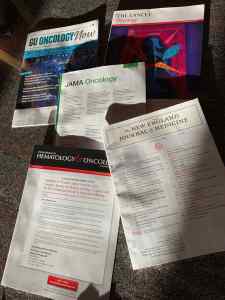
Until then, for me at least, drowning in the information for oncology in general, and even just for prostate cancer is becoming daunting. Gone are the days when reading the New England Journal of Medicine would keep you abreast of the most important advances. This is a photograph of the journals that arrived just this week, all provided for “free” (and without my request) by the endless advertising in the first pages.
In “GU Oncology Now” there is a summary of important papers presented at the Society of Urologic Oncology 2021. For prostate cancer two papers on PSMA imaging and therapy (which I have covered elsewhere), one on racial differences and treatment patterns, and an ad for “why is precision medicine complicated in advanced prostate cancer?” (See the answer here) Hematology and Oncology covers “highlights from the 2021 European Society for Medical Oncology Congress and the 2021 AUA Meeting”. That one has 4 articles on darolutamide, 3 on enzalutamide, 2 on PD-1 inhibitor trials, and “meeting abstract summaries with expert commentary”. Scanning them, I find that for the most part I have already commented on many of them in this blog, so I move on to: This week’s NEJM. There, in looking at the table of contents, I find articles on diabetes control using “closed loop” glucose monitoring and insulin administration, use of oral microbiome therapy for c. diff infections, antibiotic prophylaxis for rheumatic heart disease, and one on 24 hour urinary sodium excretion and cardiovascular risk. Whew…nothing on prostate cancer –but wait, there IS one on an antibody drug conjugate for treating lung cancer…I wonder if it could have any role in the small number of prostate cancers that also have HER-2 mutations??
Oh, well, let’s move on… The Lancet Oncology has 12 original articles, 11 commentaries and 6 letters to the editor, and there are a couple of the letters that deal with prostate cancer from researchers I know personally. But wait – they are available online at “e7” and deal with “radiographic progression-free survival in the ACIS trial”. I already know about that since I was a monitor for that trial, so guess I’ll pass. That leaves JAMA Oncology. OMG! The first three articles I really do have to read. Here it goes:
“Changes in Prostate-Specific Antigen Testing Relative to the Revised US Preventive Services Task Force Recommendation on Prostate Screening” This turns out to be an analysis of Blue Cross Blue Shield beneficiaries (some 8 million or so) aged 40-89 between 2013 and 2019. During that time, the USPSTF changed its guidelines from “not indicated” to “shared decision” and sure enough, PSA testing increased 10% among men 40-54 years old, 12% in those 55-69 years old, and 16% in the group least likely to benefit, aged 70 to 89. Hmmm.
“Association of Treatment Modality, Functional Outcomes, and Baseline Characteristics With Treatment -Related Regret Among Men with Localized Prostate Cancer” Wow – I talk to men about treatment decisions like this almost every week. This one looked at 2072 men with localized prostate cancer diagnosed in 2011 and 2012, then analyzed in late 2020/early 2021, so almost 10 years of followup. The number of interesting observations in the 3 tables and 2 figures found in the article are too numerous to go over in this blog, but among them are more treatment regret among patients who received surgery or radiation vs those who chose active surveillance, less treatment regret in college or more graduates, and as expected more regret in men who had health problems related to treatment. But the concluding paragraph says it all: “The findings of this cohort study suggest that more than 1 in every 10 patients with localized prostate cancer experience treatment-related regret. A disconnect between patient expectations and outcomes, both as it relates to treatment efficacy and adverse effects, appears to drive treatment-related regret to a greater extent than factors including disease characteristics, treatment modality, and patient-reported functional outcomes such as urinary incontinence and other urinary symptoms, erectile dysfunction, or bowel dysfunction. Thus, improved counseling at the time of diagnosis and before treatment, including identification of patient values and priorities, may decrease regret among these patients.” I guess this validates the way I often end up my own counseling sessions: “Unfortunately, Mr. (and Mrs. in some cases) XYZ, there just isn’t any way to treat the prostate gland without causing some side effects.”
“Outcomes of Screening for Prostate Cancer Among Men Who Use Statins”. This one is from Finland where we spent a lovely year on sabbatical in the mid-1980’s. My wife studied the Finns’ vaccination data for childhood meningitis, and I did a year in a molecular biology lab. We both were impressed with the Finnish Public Health system. The article utilized that system’s extensive database to evaluate the effect of statin use among 78,606 men who were part of a randomized study to evaluate PSA screening effects. The incidence of low grade (Gleason 6) cancers was reduced among the statin users, whereas detection of high risk cancers (Gleason 8-10) was similar. Buried in the data (3 figures, 2 tables) is a nugget. There is a trend towards decreased risk for all kinds of prostate cancer among statin “ever” users vs. non-users although no difference in mortality. Still…the study seems to support my bias that if tolerated (~5-10% of patients on statins develop muscle inflammation) most of my patients might benefit from being on statins.
Well, that’s it for this week’s journal arrivals. I won’t bother you with the 5-10 emails I scan every day from all sorts of “Web MD” and “Grand Rounds in Urology” places with even more to try and digest. How anybody can be a general medical oncologist these days and care for everything from lymphoma to breast cancer is truly amazing. Fortunately, there are expert resources like the NCCN Guidelines that are really helpful. Goodness knows we need them, and maybe AI will save us, but I’m not so sure.
To view this on my blog, sign up for future posts, and search for other posts regarding prostate cancer issues, please click on this link.
We made it around the sun another time, and in spite of Covid 19, are still here to thank you for your interest in this blog and most especially for your support of prostate cancer research via my annual efforts to grow a moustache and help Movember raise funds for prostate cancer research. A heartfelt thankyou!!
With all of the “Ten best” and “top songs” lists that appear this time of the year, I thought I would expand a bit on PSMA as a real game-changer that is coming on strong to change our management of prostate cancer. So what is Prostate Specific Membrane Antigen?? Well, first of all, I think you know what an antigen is, or if not, here’s a timely clue: Spike protein. When you received your vaccination with Moderna, Pfizer or J&J vaccine, you were exposed for the first time to a foreign protein that the SARS CoV2 virus (COVID-19 disease causing) uses for entering the cells that line your airways. Your body responded to this antigen (foreign protein) by developing antibodies – the levels (titers) of which prevented you from getting COVID, or at least prevented you from getting very sick. Antibodies are very specific proteins made by the B-cells of your immune system that bind to foreign antigens and are the first line of defense against invaders.
Now, if you inject a mouse with human prostate cells, the mouse will recognize all sorts of the proteins as “foreign” and make antibodies against them. In such an experiment, Wright and colleagues in the early 1990’s found that one such antibody could be useful in detecting prostate cancer. It turned out that the antibody was detecting a protein expressed on prostate cells, but also tumor blood vessels and the salivary gland that became known as PSMA. Unlike PSA, this protein is bound to the membrane of the cancer cells and doesn’t circulate in the blood stream. PSMA is actually an enzyme involved in the normal absorption of folate (a vitamin) from the intestine, but for unclear reasons, it is dramatically over expressed by prostate cancer cells. Over the next 25 years, numerous researchers worked on tagging radioactive isotopes to antibodies that would bind to PSMA and therefore could be used to detect prostate cancer or if the radioisotope was powerful enough, kill prostate cancer cells. One of the challenges, however, in using radio labeled antibodies is their size, resulting in a lot of non-specific “sticking” in the liver, spleen and elsewhere. A better approach evolved by finding small molecules that would stick to the PSMA enzyme activity site as illustrated in this figure:
As a result of this research, it became possible to develop highly sensitive PET scans that can detect much smaller metastases of prostate cancer than any previous bone or CT scans were able to do. Gallium and Fluorine isotopes hooked to the peptide (617) are rapidly becoming available in PET scan centers across the United States (and have been available for the past 3-5 years in Europe, Australia and elsewhere) and will likely become approved as the new standard for staging newly diagnosed and PSA recurrent metastatic prostate cancer. Moreover, the isotope Lu177, that emits strong beta radiation (electrons) can be attached to peptide 617 and kill cells that express PSMA.
In the VISION trial, published this year in NEJM, the use of Lu177 PSMA to treat advanced prostate cancer patients who had progressive disease after previous treatment with a second generation hormone agent (such as Zytiga or Xtandi) plus chemotherapy with a taxane (Taxotere or Jevtana) were scanned with Gallium labeled PSMA then treated with Lu177 PSMA. The treated men were compared to alternative “standard of care” which might have included other forms of chemotherapy for example. The results were extraordinary as shown in these curves.
It’s that time again. A scraggly moustache may be better than none at all, and this is the organization that has done the most, along with PCF, to make prostate cancer history. Start your own fund raiser here.
Or if you don’t want to fund raise on your own, feel free to join my campaign by visiting my Movember Website.
Movember has made a HUGE difference in prostate cancer awareness globally by sponsoring research at every level -from clinical to basic science and the creation of data bases like the GAP3 project. Many of the posts I have written this last year like the ones on PSMA PET scans and Lu177-PSMA therapy are the direct result of Movember funding. Let’s keep the progress rolling!
To view this on my blog site, sign up for future posts, and search for other topics I have covered on prostate cancer, please click here.
OK, I will admit right up front to bait and switch. In the last month I have seen two of my patients who are what the public health aficionados call “positive deviants“. One man is a professional who still goes to work every day. I have been seeing him for about 5 years; he has metastatic cancer in many bones and lymph nodes, a PSA in the 100’s, yet other than being a bit too thin, carries on with his life helping other people in his chosen profession. The second gentleman looks like an olympic athlete – great muscle preservation, a military posture, and also continues to work at his regular job in spite of having “mCRPC” which most readers will know as metastatic castrate resistant prostate cancer. What is it they do far more than most of my other patients? What is their secret diet? …EXERCISE
In this piece from the New York Times on heart health, Dr. Emery, a cardiologist, refers to exercise as a magic pill. “It’s just that you can’t swallow it, you have to earn it,” he notes. You need to click on that hyperlink and read the whole article. These are the benefits for heart health:
It enhances the cardiorespiratory system.
It increases HDL cholesterol.
It lowers triglycerides, a type of fat that circulates in the blood.
It reduces blood pressure and heart rate.
It lowers inflammation and improves blood sugar control.
Best of all, exercise is the type of medicine that appears to produce benefits no matter how small the dose.
But what about prostate cancer you might ask? The studies there are compelling. In a recent article from Taiwan, 125 patients who were treated with ADT and radiation for high risk prostate cancer were studied for changes in body composition. The patients experienced a 5.5% loss in skeletal muscle over 180 days, and each 1% loss of the skeletal muscle index resulted in a 9% increase in non-cancer mortality! Although it is a small study and it is shocking, but it illustrates the problem of taking testosterone away from older men. You don’t need to rely on small studies however. In the Health Professions Follow-Up Study, 2705 men diagnosed with prostate cancer were followed from 1990-2008. “Men with ≥ 3 hours per week of vigorous activity had a 61% lower risk of PCa death (HR, 0.39, 95% CI, 0.18 to 0.84; P = .03) compared with men with less than 1 hour per week of vigorous activity. Men exercising vigorously before and after diagnosis had the lowest risk.”
So, the message is clear. Compared to any “diet changes” you can make, or supplements you might take, exercise is definitely more important to enhance your chances of surviving prostate cancer. Ideally, you should work with a trainer who can help you develop an individualized program that takes into account your current physical fitness. From the NYT article, here is a place to start if you don’t have access to a trainer:
“Anything is better than nothing. But the ideal dose of exercise for adults, according to the Centers for Disease Control and Prevention, is as follows:
150 minutes of moderate-intensity aerobic exercise a week.
2 sessions of about 30 minutes each of resistance training a week.
You can spread the aerobic activity throughout the week however you like, such as 30 minutes five days a week, or 50 minutes three days a week. Examples include running, swimming, brisk walking, riding a bike, playing basketball or tennis, and doing yard work. As for strength-building activities, ideally, you should set aside at least two days a week for 30 minutes of exercise that works the major muscle groups, such as the legs, back, shoulders and arms. What counts as strength training? Lifting weights, using resistance bands, doing bodyweight exercises like yoga, push ups and sit ups, and even heavy gardening with a lot of digging and shoveling. Vigorous exercise should get your heart rate up to 70 to 85 percent of your maximum heart rate. Not sure what that is? Here’s how to calculate it.” I also recommend your resistance training should utilize weights that cause your muscle group to “fail” on the second or third set of repetitions.
So there you have it – how to change your “diet” to beat prostate cancer. Definitely not as easy as just avoiding red meat and increasing soy products, but almost certainly the most effective thing you can do. Movember is coming up. Time to MOVE!
As I’m sure most of you know, this has been a controversial topic for more than 2 decades. The problem is fairly simple: Screening can pick up earlier disease, save some lives, but treatment has side effects for virtually 100% of men who get treated, and “active surveillance” is not a picnic with repeat biopsies every 2-3 years. We may have to treat as many as ten men to save one life. On the other hand, if they live long enough, more than half of men probably develop prostate cancer, usually of the low grade (Gleason 6 or less) type that will never bother them. Here is a nice article that shows how autopsy series over time have found prostate cancer in up to half of men, dependent on age, race, etc. but notably pointing out how seldom autopsies are now performed compared to earlier eras. The reality is that we have no idea these days how many 90 year old men would have a small cancer if we really looked hard for it. What we understand is that they didn’t need to know they had a prostate cancer if they were never treated and died from something else.
Now, add to these challenges the revolution in cancer detection provided by molecular testing. This field is moving so fast that the “old idea” of PSA screening is becoming passé. For example, Illumina, the company that makes automated next generation sequencing machines spun off a startup, GRAIL that developed a “pan-cancer” test that looks for fragments of DNA circulating in the blood, the fingerprints for most of the common cancers. This test, called “Galleri” is undergoing real world testing in the UK, but is not covered or approved in the U.S. Proponents (some of whom are consultants for biotech companies) suggest that it could save “millions of lives”. The test, because we live in a free, capitalistic society is already marketed on the internet for an out-of-pocket price of only $949 with payment plans available. But…and the prostate cancer community knows this perhaps better than any other…the challenge of knowing whom to test, when to test, and what to do with a positive test may take decades to figure out. Here’s an article covering some of those promises and challenges (false positives, lead time bias, costs for treatment, etc.)
But for prostate cancer, the same DNA technology is making real progress. What we want are tests that not only tell us who has prostate cancer, but who has the kind of cancer that NEEDS to be treated or followed closely, and lowers the detection of clinically insignificant cancers. An example of this kind of testing sophistication appeared in NEJM this month from a group in Stockholm. This group has developed a test called Stockholm3 that is “a risk-prediction model that is based on clinical variables (age, first-degree family history of prostate cancer, and previous biopsy), blood biomarkers (total PSA, free PSA, ratio of free PSA to total PSA, human kallikrein 2, macrophage inhibitory cytokine-1, and MSMB), and a polygenic risk score (a genetic score based on 254 single-nucleotide polymorphisms [SNPs] and an explicit variable for the HOXB13 SNP) for predicting the risk of prostate cancer with a Gleason score of 7 or higher.” They then took men at risk of having prostate cancer (PSA>3 and Stockholm3 >11%) and either did “blind” 12 core biopsies or did an MRI first and included targeted biopsies of high risk lesions only if seen on the MRI.
Outcome for Stockholm3 high risk screened men with PSA > 3 who did or did not have MRI targeted biopsy in addition or instead of standard biopsy.
Note that the number of biopsies needed went down, as did the number of benign or clinically insignificant cancers. This is the sort of effort that will eventually reduce the number of men having unnecessary biopsies or treatment by combining all of the great new molecular and radiology technologies (dynamic contrast enhanced MRI’s). We now routinely use some of the molecular tests to help us in screening and deciding about treatments as I reviewed in this blog.
While we are still a long way from applying this kind of technology to “every man over 50”, the future for the next generation (our sons and grandsons) will be much better – fewer unnecessary biopsies and treatments. Hopefully this type of approach can be applied to the pan-cancer type of “Galleri” screening being proposed, and make such testing cost effective as well. Congratulations to the prostate cancer researchers and their patients for leading the way!
A cancer diagnosis affects every patient in a different way. However, regardless of what type of cancer is involved, it is a cold water “slap in the face” that we all share the same fate: “our days are numbered” – something everyone knows but we generally find it more convenient to simply not think about.
Prostate cancer, in my opinion, is somewhat different in this regard for most men. First, like all cancers, it is clearly a disease of aging, but even more so. The median age at the time of diagnosis is 66 years. This means the majority of newly diagnosed men have lived a reasonably long (and hopefully healthy) life. There has been time to deal with other health threats, watch children grow, and usually face the deaths of parents or close family members. However, the good news is that the vast majority of men will still have the opportunity for enjoying many more years of living.
In fact, regardless of race or ethnicity, over 90% of men newly diagnosed with prostate cancer will be alive in 10 years. These data hold true even for men with regional disease, but fall off rapidly if metastatic disease develops. And there is continued improvement in treatment for the metastatic patients as well. In a recent article looking at three large studies for the benefit of second generation androgen receptor antagonists (enzalutamide, apalutamide, darolutamide) to delay metastases and improve survival, even men >80 years of age clearly did better than before.
So the question becomes, “what will you do with the time you have left?” regardless of how long that is. My thought, having just returned from volunteering at the Epic Experience cancer camp, is that it always good to take some time and reflect on how you want to spend that time. Write another paper? Start another company? Make even more money? Grasp for the latest treatment option? Or potentially reconsider family and friends and what really matters to you. The Epic organization has had trouble recruiting men to their camps, but for the men who have come, their perspectives have been altered in very positive ways as you will see in this video. Many more women come to the camps, just as women have led the way in advocating for breast cancer research, and in general reaching out via support groups. We have a lot to learn from them!
There are many support groups out there for prostate cancer survivors of all stages. Prostate Cancer Foundation has put a nice list together here. And if you would like online support for specific issues, Movember’s True North initiative has great articles to help you here.
The bottom line for me, having had a chance to “get back to camp”, is that we can all use a little encouragement to get out there and live again as we come out of our COVID isolation. I hope you will do just that this summer!
To view this post on my blog site, sign up for future posts, and be able to search for previous posts, please click here.
The presentation that received the most attention from readers of this blog and the press at this year’s ASCO meeting was the one about Lu-177-PSMA-617 for patients with advanced, metastatic castrate resistant prostate cancer (mCRPC). I have previously posted about PSMA and this approach to treatment as you may want to review here. Briefly, Prostate Specific Membrane Antigen, is a protein expressed on the surface of prostate cancer cells. There are molecules (ligands) that bind to this protein and can be tagged with radioactive isotopes. Thus, the tagged ligand, once injected, carries the isotope to the tumor cells. If the isotope is a positron emitter, a CT-PET scanner (Positron Emission Tomography) will light up the tumor’s location. Examples include Ga-68 and F-18. If the isotope releases stronger radiation, (for example Lu-177 releases strong beta particles that can kill cancer cells, just as the approved agent, Radium 223 -aka Xofigo™ -is a bone seeking agent that seeks out bone metastases and kills cancer cells by releasing strong alpha particles) then prostate cancer cells expressing PSMA will be killed.
The data presented at ASCO 2021 on Lu-177-PSMA-617 was from a large phase III trial comparing Lu-177-PSMA-617 with “standard of care” in patients who had progressed on most other therapies. The results are shown in the following figure:
Slide from presentation on Cancer.net, 6/16/2021.
These data will be evaluated by the FDA and it seems likely this new therapy will be approved. The answer to the question of “what’s next?” for a new drug is usually to study its use in earlier stages of disease. What if patients who have metastases but have not yet been treated with hormonal manipulation were to receive the drug at the same time they start hormonal treatment? What if used before prostatectomy? There are 9 such ongoing trials you can read about here. The hope is, that by using the drug earlier, even more benefit will result, and this is often the case in cancer medicine – for example using early “adjuvant” chemotherapy in high risk breast cancer, or using apalutamide (Erleda™) at the outset when initiating prostate cancer ADT in high risk patients.
As we progress in our understanding of when and in whom to use more aggressive therapies, it will also be helpful to identify the patients at greatest risk for failing one treatment or another. In an article appearing this month in Annals of Oncology, investigators evaluated tumor DNA levels after a single cycle of abiraterone (Zytiga™) and found that patients who didn’t have circulating tumor DNA at the start or converted from positive to negative had significantly better overall survival than patients who did not convert to negative. This means that as soon as 30 days after starting abiraterone, you could already pick out patients in whom you might want to change therapy or add other agents to treatment. They also showed that patients with alterations in specific genes like TP53, RB1 or PTEN either at pretreatment or after one cycle had significantly shorter overall survival. This kind of individualizing risk analysis will further enhance the ability to introduce new drugs like Lu-177-PSMA-617 earlier in patients who need it and avoid toxicities in those who don’t.









 prost8blog